A Marketing Strategy lesson
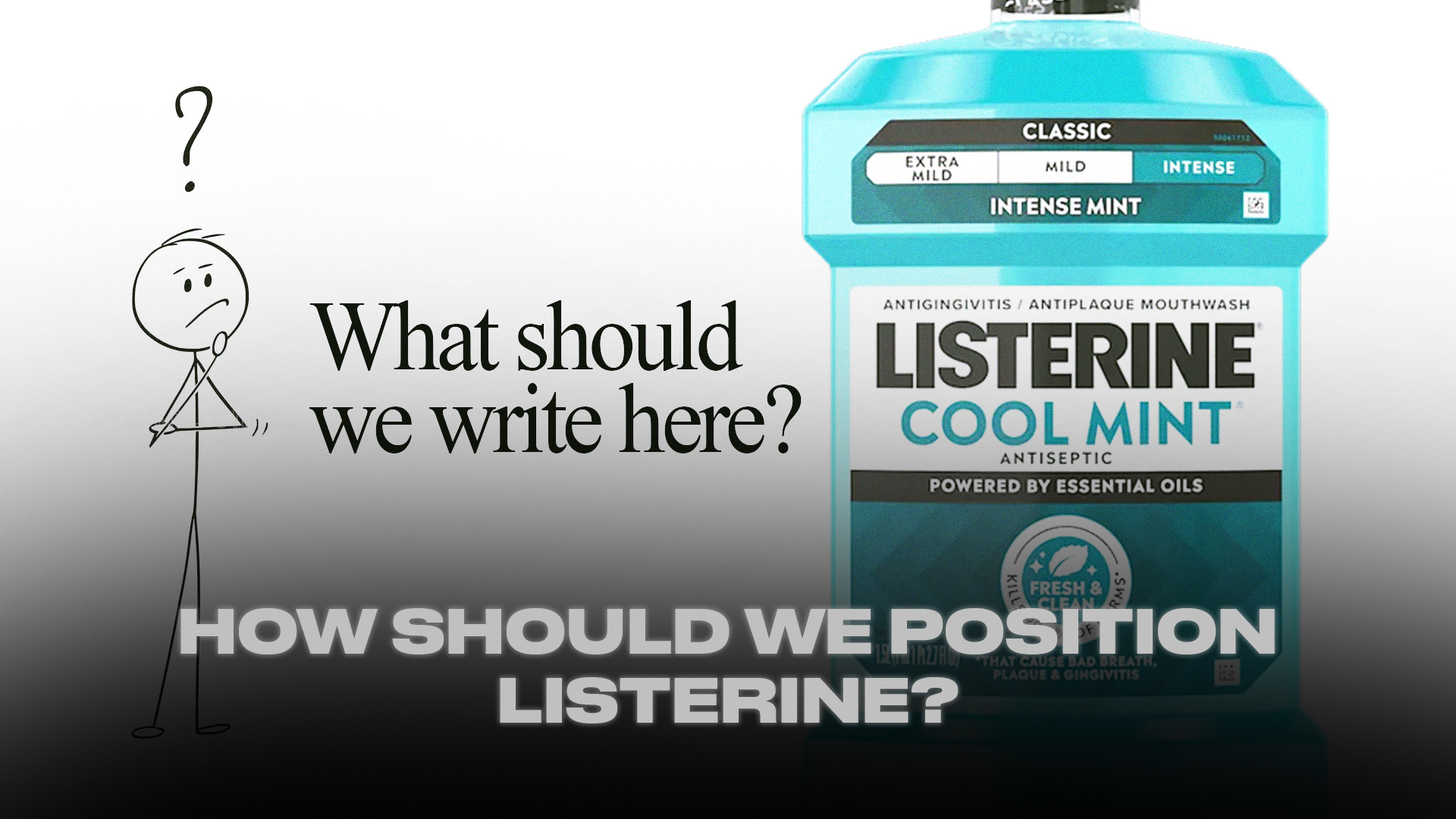
I’ve mostly worked at startups, where “marketing” usually means wearing all the hats. But at its core, product marketing always comes back to the same thing: building a strong go-to-market strategy, which of course includes positioning and messaging. Different products demand very different communication strategies. Selling cloud infrastructure to enterprise CTOs is nothing like selling ice cream. But even a simple case requires a rigorous strategic process.
A big part of my job is figuring out how to bring a product to market. Not the individual channels, ad design or campaign ideas, but the foundational strategy. The big picture question…what are we actually selling?
So, to explain to people what I do, I often use a very simple example.

If I were leading marketing strategy for Listerine, would I go-to-market with:
1. Kills 99% of germs
2. Kills bad breath
Both are true, both are compelling.
But which one would make products fly off the shelf?
It’s easy to say “oh obviously 99% of bad germs” or “everyone wants to have good breath”, but we can’t just make a $100 million launch on assumptions. So, let’s dive in and see what we can find.
Let’s design a simple test to see what actually resonates with consumers.
We could set up a controlled test group and compare reactions side by side. Or build a few ads that lead to landing pages with mocked-up product bottles and measure which version drives more conversions. We could even run sampling programs in key markets and track lift and repeat interest.
Now we get back the results, and we see that “kills 99% of germs” has outperformed by a whopping 15%! Home run! Right?
…right?
Well, not necessarily.
What if a deeper look at the data reveals a strong signal that there’s a large demographic divide.
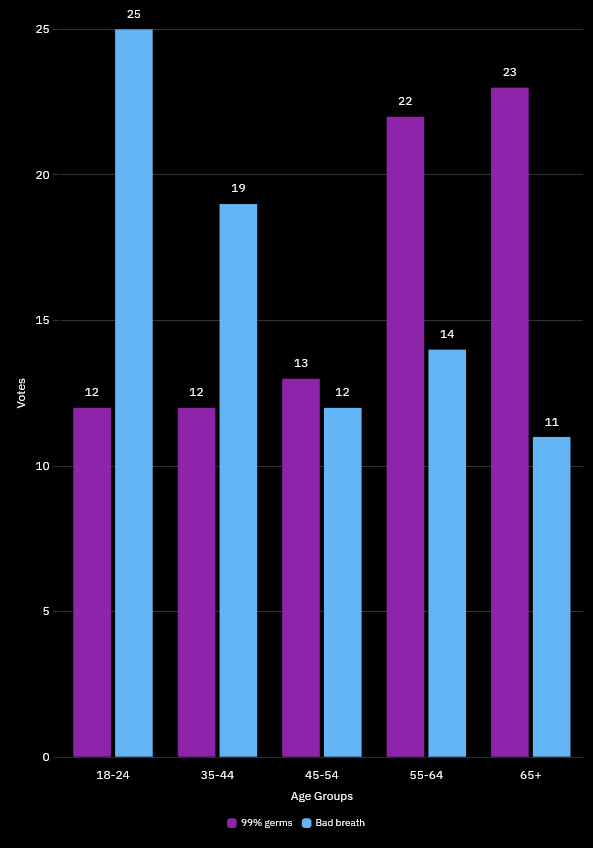
What we can see here is that ages 55+ really resonate with the “Kills 99% of germs” messaging, whereas 18-44 year old really resonate with “Kills bad breath”.
And this makes sense when you think about it. “Kills bad breath” is a social message. Younger consumer are thinking about first dates, meeting new friends in college, and job interviews. Bad breath carries a lot of anxiety because it can instantly undermine those situations.
“Kills 99% of germs” is a health message. It speaks to responsibility and long term care. Older consumers are more likely o have experiences tooth or gum issues, and may have heard from their doctors that oral is linked to heart health.
But let’s move forward. If both messages work, we can just pick one and call it a day, right?
Well, not exactly!
We can’t evaluate these segments in a vacuum, they have to be considered in the context of the business. So now our question gets flipped on it’s head.
“What resonates?” has become, “What resonates, and who are we trying to win?”
Well…
Younger audiences are generally easier to win, but harder to retain.
Their buying habits tend to be more brand agnostic than older consumers. They have endless options, are highly influenced by trends, and move between products quickly. To retain them, a brand has to consistently show up across a fragmented media landscape and stay culturally relevant. On paper, their lifetime value could be longer because they have more years ahead of them.
Older audiences, are more expensive to acquire, but are far more loyal.
They’re often reachable through traditional channels like TV, radio, and print, and they tend to trust authority figures such as doctors. Once they find a product that works, they stick with it. A 50 year old who builds something like Listerine into their daily routine is likely to remain a customer for years. They also typically have greater purchasing power and are willing to spend a bit more than their younger counterparts.
| Older Consumers | Younger Consumers | |
|---|---|---|
| Spend Amount | Higher | Lower |
| Acquisition | Traditional, more expensive | Digital, less expensive |
| Retention | Higher brand loyalty | Lower brand loyalty |
| Lifetime Value | Shorter potential timeline | Longer potential timeline |
The conflict here is clear.
The older consumer is harder to reach but much easier to retain, and has an assumed shorter lifecycle.
The younger consumer is easier to acquire, harder to retain, but has a longer lifecycle.
From here, the next step is the quantify the inputs and model what each customer segment actually looks likes.
We convert these inputs into an equation and calculate the LTV for each.
LTV Calculator
LTV = Lifetime Purchases × Avg. Price
And then you can make an informed decision!
This is a basic look at the broad strokes of marketing strategy, focused on positioning. Choosing words is “easy”, but you need to always understand the big picture and the business implications. We leave as little to chance as possible, and test everything before we make a multi-million dollar investment.
And in this scenario, I would push to create a subbrand that’s exclusively promoted in digital and select retail markets surrounded college campuses.